
Project Overview
This lecture recital, held on November 11, 2024, was the culmination of a research and performance project supported by the Kilmer Research grant at SUNY Potsdam. The project investigates the role of music as a means of survival, resistance, and expression for Jewish string musicians during the Holocaust. Through a combination of archival research, historical analysis, and live performance, I aim to honor the works of the composers who contributions to music history were shaped—and in many cases, silenced—by Nazi persecution.
Project Focus
The Holocaust presents a complex landscape in which music became both a tool of oppression and a lifeline for many Jewish musicians. In concentration camps and internment sites, music was used to manipulate and control, but also to connect, preserve identity, and resist erasure. This project explores the nuances ways Jewish string musicians engaged with their instruments and compositions during one of history’s darkest periods.
Composers and Works
The recital centers on five composers whose careers intersected with the Holocaust and whose works offer insight into the emotional, cultural, and political realities of their time. A Czech composer known for his modernist style, Hans Krása was imprisoned in Terezín, where he continued to compose and lead performances before being murdered within the concentration camps. His music reflects both his deep artistic sensibilities and the resilience of creativity under persecution. His “Passacaglia and Fuga” (1944) for string trio (violin, viola, and cello) is his last known composition, completed shortly before his death. A brilliant young Moravian composer and pianist, Gideon Klein, completed some of his most profound works while imprisoned in Terezín. He was deported and murdered under unknown circumstances at twenty-five years of age, but his music endures as a striking testament to his talent and vision. His “Trio for Violin, Viola, and Cello” (1944) is his last known composition, completed nine days before his death. An accomplished Austrian composer, Viktor Ullmann composed prolifically in Terezín, where he played a central role in the camp’s musical life as he was employed by Nazis to produce propaganda music for Terezín. His incarcerated works demonstrate a turn to string instruments and engagement with resistance. His Third String Quartet (1943) was the first work Ullmann composed while in the camp and evokes emotional distress. A Viennese-born composer, Hans Gál fled Nazi capture and was later interned in a Scotland internment camp. Despite these displacements, he remained committed to writing upbeat music of hope and clarity throughout his life. His “Sonata for two violins and piano in C Major” (1941) demonstrates the liveliness Gál aspired to convey during the darkest times in his life. A Polish composer, Szymon Laks, survived Auschwitz by playing in—and eventually conducting—the camp orchestra. His postwar writing offers a rare and nuanced account of music’s double-edged role in the camps. Written before his imprisonment, his “Polonaise pour violon et piano” (1953) offers a conflicting tonal and atonal work with a heavy influence of Polish folk tunes fitting efficiently within the violin’s physical capabilities.
Research Approach
To understand the context behind the music, I conducted archival research at the Museum of Jewish Heritage and the Amud Aish Museum in New York City. Both museums introduced me to experts or descendants of the Holocaust, and allowed me access to public and private archives. I prioritized primary documents and artifacts, testimonies, and music manuscripts to gain an intimate perspective on the lives behind the scores. Incarcerated composers turned to string instruments because of their accessibility—unlike reed or wind instruments, strings did not rely on fragile, replaceable parts like reeds or mouthpieces, making them more practical in environments with limited resources and restricted access to materials. Through this discovery, I specialized my project towards string musicians and composers.
Presentation and Performance
The lecture recital was presented to an audience of students, faculty, and community members across Northern New York. The program included live performances, narrative storytelling, and historical framing of each composer and piece. A Q&A and post-recital reception allowed further conversation on the intersections of memory, history, and music.
Explore the Program
To access the recital, please contact Alyssa directly at [email protected]
SUNY Potsdam Learning and Research Fair 2025
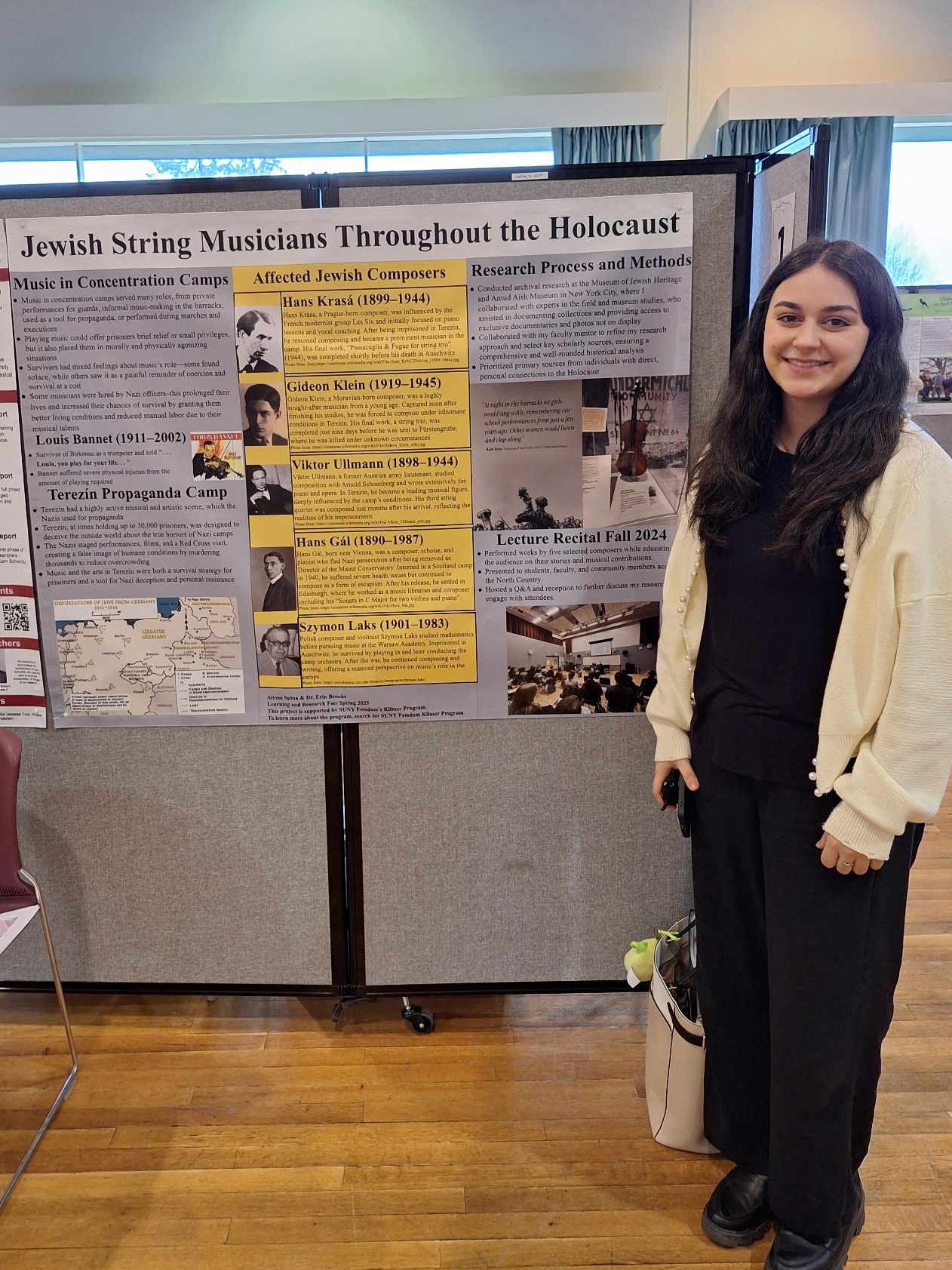
Alyssa presented at SUNY Potsdam’s annual Learning and Research Fair, 2025, where she earned first place in the humanities section of the research competition.
This project is supported by SUNY Potsdam’s Kilmer Program. To learn more about the program, search for SUNY Potsdam Kilmer Program.
 Alyssa Spina Musicology